Online relationships can start with something as simple as a message, a dating-app match, or a new social media connection. Unfortunately, scammers use the same platforms to create fake identities, build trust, and eventually ask for money or personal information.
One of the quickest ways to investigate a suspicious profile is a romance scam reverse image search. By checking where a person’s profile photo or face appears elsewhere online, you may discover stolen images, duplicate dating profiles, different names attached to the same face, or previous scam reports.
In 2025, nearly 60% of people who reported losing money to a romance scam said the scam started on social media, according to the Federal Trade Commission.
What Is a Romance Scam?
A romance scam happens when someone creates a false online identity and builds an emotional relationship with another person for financial or personal gain.
The scammer may contact you through:
- Dating apps
- Telegram
- Other social or messaging platforms
At first, the conversation may seem completely normal. The person might message frequently, show strong interest in your life, and quickly try to build an emotional connection.
Eventually, however, their story often leads to a reason they cannot meet you in person.
They may claim to be:
- Working overseas
- Serving in the military
- Traveling for business
- Working on an offshore project
- Dealing with a medical emergency
- Unable to access their own money temporarily
The FBI warns that romance scammers commonly create believable reasons for avoiding an in-person meeting before introducing a financial emergency or another request for money.
Why Romance Scammers Use Stolen Photos
A fake dating profile needs to look believable.
Instead of using their real identity, scammers often use attractive or trustworthy-looking photographs belonging to someone else. These images may come from public social media accounts, influencers, professionals, models, or other publicly available profiles.
More recently, scammers can also use AI-generated faces instead of stealing an existing person’s photograph. The FBI has warned that criminals are using generative AI to create realistic fictional social media profiles and images for romance and financial fraud schemes.
This means there are now two important possibilities when investigating a suspicious profile:
The photo was stolen from a real person.
or
The person in the photo may not exist at all.
That is why photo verification should be one part of a broader scam check.
How Reverse Image Search Helps Detect Romance Scams
A reverse image search works differently from a normal Google search.
Instead of typing a name or keyword, you upload a photograph and search for other places where that image—or potentially the same face—appears online.
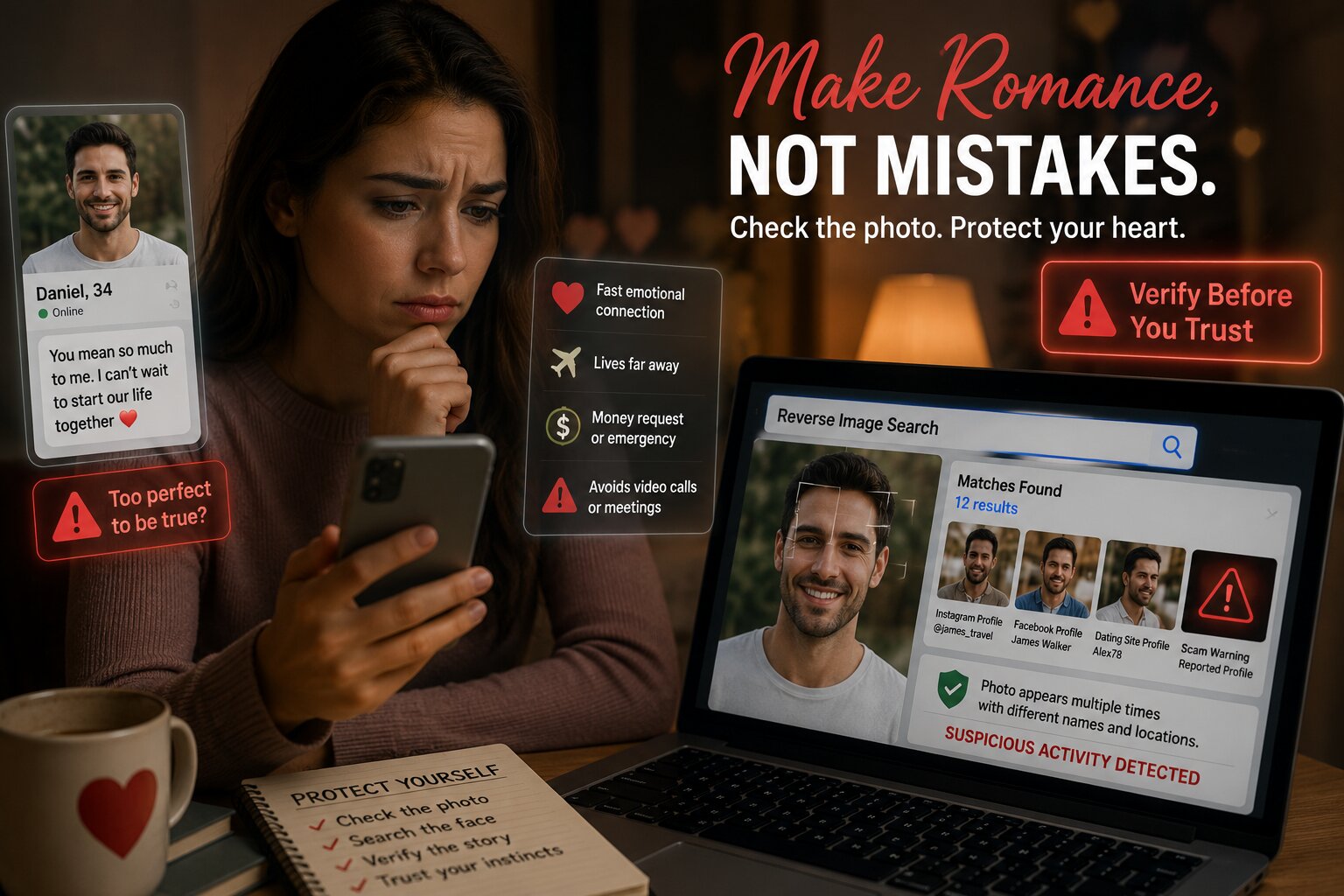
For example, imagine someone tells you their name is Daniel and that they live in Germany.
You search their dating profile photo and discover the same face connected to:
- A different name on another social account
- Several unrelated dating profiles
- An older public profile belonging to someone else
- Scam warning pages
- Social media accounts from another country
Those results do not automatically prove every profile is fraudulent, but major identity inconsistencies are a strong reason to investigate further.
The FTC specifically recommends performing a reverse image search on the profile picture of a suspected romance scammer and checking whether the image appears under another name or with conflicting information.
How to Check a Dating Profile Photo with FaceFinderLens
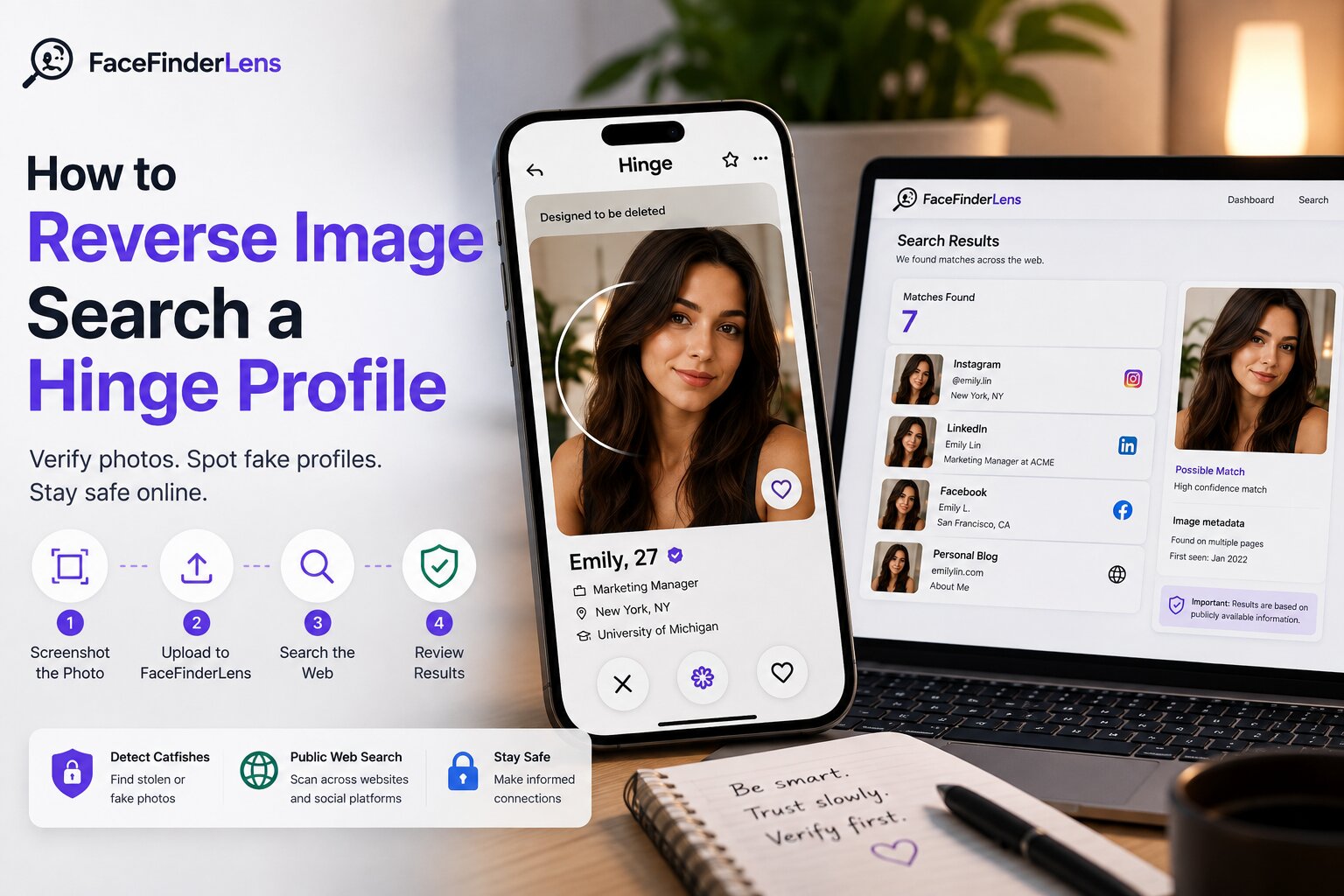
Step 1: Save the Clearest Photo
Start with the clearest available picture of the person’s face.
You can:
- Save a profile photo
- Take a screenshot
- Crop a photo from a conversation
- Use another clear image they have sent you
Whenever possible, choose a photo where the face is visible from the front and is not heavily covered by sunglasses, masks, filters, or other objects.
Step 2: Crop Unnecessary Elements
If you are using a screenshot from Tinder, Bumble, Hinge, Facebook, Instagram, or another app, crop away unnecessary interface elements.
Keep the person’s face as clear as possible.
This gives the search system more useful visual information to analyze.
Step 3: Run a Reverse Face Search
Upload the photo to FaceFinderLens Reverse Image Search.
The goal is to identify other public appearances of the same face or photograph across indexed online sources.
Pay attention to:
- Different names
- Different locations
- Older appearances of the photo
- Other dating profiles
- Public social profiles
- Scam-related pages
- Multiple identities connected to the same face
Step 4: Search More Than One Photo
Do not rely on a single image.
If the person has shared several photos, search two or three separately.
One image may produce no useful matches while another may have appeared publicly for years.
How to Interpret Your Reverse Image Search Results
Same Face, Different Name
This is one of the strongest warning signs.
For example, if someone introduces themselves as “Michael” but the same face appears on an established account belonging to “David,” the dating profile may be using somebody else’s identity.
Investigate the oldest and most credible source before drawing conclusions.
Same Photo on Multiple Dating Profiles
Seeing the same photo associated with different ages, locations, occupations, or names should raise concern.
A scammer may reuse one stolen identity across several platforms.
Photo Appears on an Established Social Profile
This may help you locate the original source of the image.
Compare:
- The person’s name
- Location
- Age
- Occupation
- Posting history
- Dates when photos were published
A long-standing social profile whose details conflict with the person you are talking to may indicate that the dating profile copied those images.
Photo Appears on Scam Warning Pages
This is a serious red flag.
However, verify the source carefully. User-generated scam reports can sometimes contain mistakes, so compare multiple pieces of evidence.
No Matches Found
No search results do not prove that a profile is legitimate.
Possible reasons include:
- The image is new
- The original profile is private
- The page has not been indexed
- The image was heavily edited
- The scammer generated the face using AI
- The source exists on a platform that search engines cannot access
Think of reverse image search as an investigation tool—not a guarantee of someone’s identity.
Romance Scam Red Flags to Watch For
A suspicious photograph becomes much more important when combined with suspicious behavior.
They Avoid Video Calls
A scammer using someone else’s photographs cannot easily appear live as that person.
Repeated excuses about broken cameras, poor connections, security restrictions, or work schedules should make you more cautious.
The Relationship Becomes Serious Extremely Fast
Romance scammers often try to build emotional dependence quickly.
You may hear statements about love, marriage, destiny, or a future together unusually early in the relationship.
They Can Never Meet in Person
One cancelled meeting can happen.
A continuous cycle of excuses is different.
The person may repeatedly claim to be overseas, deployed, working offshore, traveling, or dealing with emergencies.
They Ask for Money
This is the biggest warning sign.
Requests may involve:
- Emergency medical expenses
- Travel tickets
- Customs fees
- Visa expenses
- Business problems
- Gift cards
- Cryptocurrency
- Investment opportunities
The FTC advises people not to send money or gifts to an online romantic interest they have never met in person.
They Introduce an Investment Opportunity
Modern romance scams sometimes evolve into investment fraud.
After building trust, the scammer may introduce cryptocurrency, trading, or an investment platform where fake profits appear on screen.
Do not allow someone you met through dating or social media to control your investment decisions.
Reverse Image Search vs Face Search
These two technologies are related but are not exactly the same.
Traditional Reverse Image Search
Traditional image search is especially useful for finding:
- Exact copies
- Cropped versions
- Resized images
- Original image sources
- Websites using the same photo
Google Lens and TinEye are common examples.
Reverse Face Search
Face-oriented search focuses more specifically on facial characteristics.
That can be useful when a scammer uses several different photos of the same person instead of repeatedly using one identical picture.
For romance scam investigations, using both approaches can provide more information than relying on one method alone.
What If the Scammer Uses an AI-Generated Face?
This is becoming increasingly important.
A traditional stolen-photo search may find nothing if the profile image was created entirely by an AI image generator.
Look for additional warning signs such as:
- Unusual hair edges
- Inconsistent earrings or accessories
- Strange teeth
- Unnatural background objects
- Asymmetric glasses
- Distorted text
- Very smooth or artificial-looking skin
But visual inspection alone is becoming less reliable as AI improves.
Combine several checks:
- Reverse image search
- Face search
- AI-image detection
- Video verification
- Profile-history checks
- Behavioral red flags
A lack of reverse-search results should never be treated as proof that someone is genuine.
What to Do If You Think You’re Talking to a Romance Scammer
Stop Sending Money
Do not send additional payments, cryptocurrency, gift cards, bank transfers, or account information.
Save Evidence
Before blocking the account, keep copies of:
- Profile screenshots
- Messages
- Phone numbers
- Email addresses
- Payment requests
- Transaction details
- Reverse image search results
These may help when reporting the scam.
Report the Account
Report suspicious profiles directly to the dating app or social media platform where you encountered them.
Report the Fraud
In the United States, romance scams can be reported to the FTC and the FBI’s Internet Crime Complaint Center (IC3). The FBI advises victims to stop contact with the scammer and report the incident.
Contact Your Payment Provider
If you already sent money, contact your bank, card provider, payment app, cryptocurrency exchange, or transfer service as quickly as possible.
Recovery is not guaranteed, but acting quickly can improve your options.
How to Reduce Your Risk Before Getting Emotionally Invested
The best time to verify an online identity is early.
Before trusting a new online connection:
- Search their profile photo
- Search more than one image
- Check whether their name matches their online history
- Ask for a live video call
- Look for inconsistencies in their story
- Avoid sending money
- Be cautious with investment advice
- Protect personal and financial information
Verification does not need to feel like an investigation.
A quick check can simply help confirm that the information someone gives you is consistent with their public online presence.
Use FaceFinderLens to Check a Suspicious Profile Photo
If something about an online dating profile does not feel right, a photo can provide another starting point.
Upload a dating-app screenshot or profile picture to FaceFinderLens and search for other public appearances of the same face.
Look for matching profiles, reused photos, conflicting names, or other clues that can help you decide whether more verification is needed.
Start a Catfish Reverse Image Search →
Frequently Asked Questions
Can reverse image search find a romance scammer?
It can help identify stolen photographs, duplicate profiles, and conflicting identities. It cannot guarantee someone’s real identity, so combine the results with other verification methods.
What is the best photo to use for a romance scam search?
Use a clear image where the person’s face is visible from the front. Avoid extremely blurry images, heavy filters, masks, or photos where the face occupies only a small part of the image.
Can I reverse image search a Tinder or Bumble screenshot?
Yes. Crop the screenshot so the person’s face is clear and unnecessary interface elements are removed before searching.
Does no result mean the profile is real?
No. A photo may be private, new, unindexed, heavily edited, or AI-generated.
What should I do if the same photo appears under another name?
Compare the sources carefully. Check publication dates, established social profiles, locations, and other information. If an established identity clearly conflicts with the person you’re speaking with, treat the profile as suspicious.
Can scammers use AI-generated profile pictures?
Yes. The FBI has warned that criminals use generative AI to create realistic images and fictional social media personas for fraud schemes.
Should I confront someone if I discover stolen photos?
It is generally safer to preserve evidence, stop contact, block the account, and report it to the relevant platform or authorities rather than continuing the interaction.