
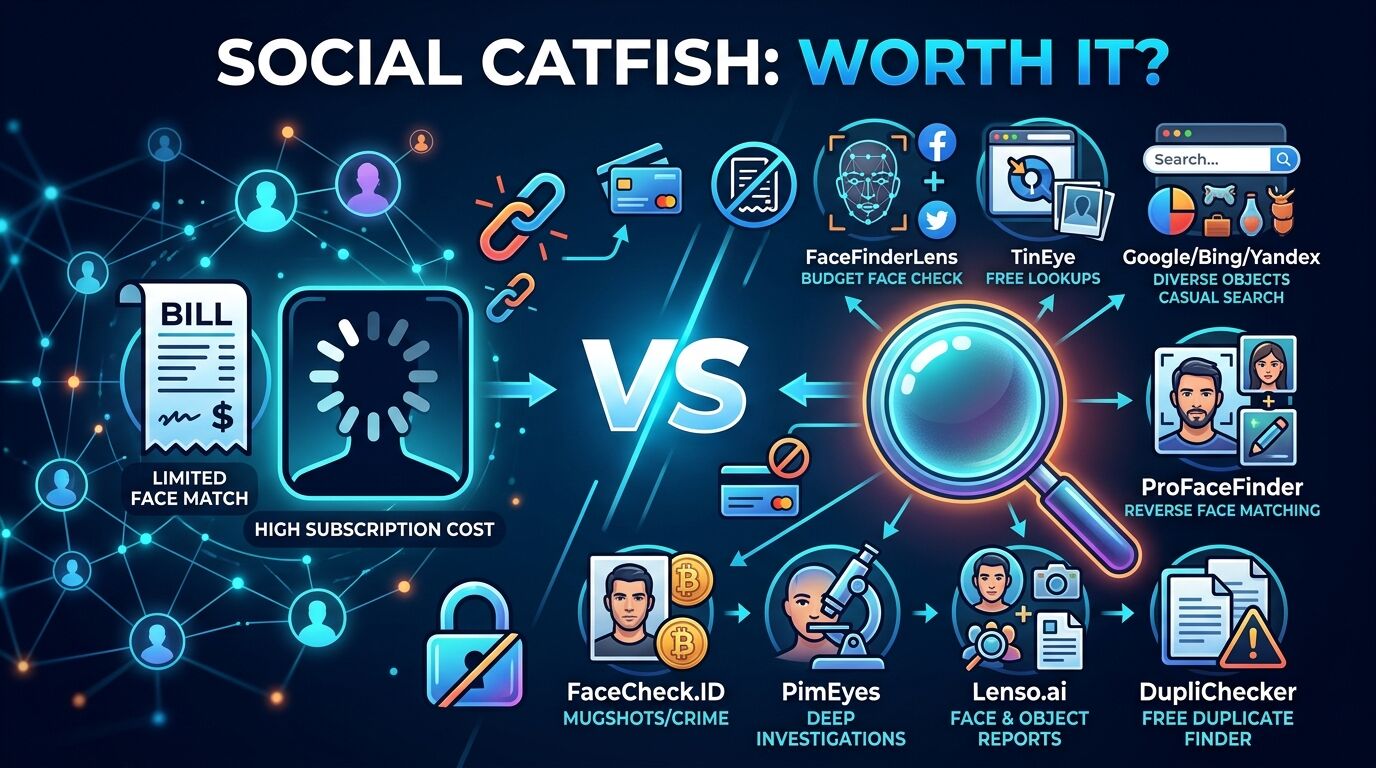
Social Catfish is one of the most recommended tools for checking whether a dating app match is using someone else’s photos. It’s also one of the most complained about — and the reverse image search feature that gets it recommended is the part that performs worst.
Here’s what the criticism actually amounts to, and eight alternatives that do the photo lookup job more precisely, more cheaply, or both.
The Case Against Social Catfish for Photo Lookups
Two complaints dominate user reviews, and they’re worth separating because they’re different problems.
Billing. The most frequent Trustpilot complaint concerns the trial pricing. Users report signing up for a low introductory fee — commonly cited as $1.99 — and subsequently being charged substantially more, in the $25–$40 range, when the trial converts. Whether that’s disclosed clearly enough is a matter of opinion; that it repeatedly surprises people is not.
Results. The more substantive issue is that the photo search underdelivers. Social Catfish is a public-records aggregator that happens to include reverse image search, not a face recognition engine. Its image results skew toward visually similar pictures rather than the same person, and they frequently omit the two things you actually need: a name, and a source link you can open.
That’s the structural limitation. For a background check where you already have a name or phone number, Social Catfish is a reasonable product. For a photo-first question — who is this, and where else does this face appear? — a dedicated face recognition tool will beat it consistently.
The Alternatives at a Glance
| Tool | Best for | Pricing |
|---|---|---|
| FaceFinderLens | Budget face checks, catfish detection, stolen photos | From $3.95 |
| TinEye | Free lookups for objects, famous faces, image copies | Free; API from $200 |
| Google / Bing / Yandex | Casual free searches for public figures and viral images | Free |
| ProFaceFinder | Reverse face matching on edited photos | $8–$12 |
| FaceCheck.ID | Face identification, mugshots, crime-related matches | $19–$597 (crypto only) |
| PimEyes | Deep face searches and sustained investigations | $30–$300/mo |
| Lenso.ai | Combined face and object reports | $17–$2,400 |
| DupliChecker | Free duplicate and image copy tracking | Free; from $5.40/wk |
1. FaceFinderLens — Best Budget Face Recognition Tool
FaceFinderLens does the specific thing Social Catfish is usually recommended for, without the aggregator overhead. It’s a face recognition engine, so it matches facial geometry rather than image files — which means it finds the same person in a different photo, not just copies of the same photo.
It searches across social platforms (TikTok, X, Instagram, Snapchat), dating apps (Tinder, Bumble, Hinge), professional sites like LinkedIn, and news outlets, and it holds up on the messy inputs this work usually involves: cropped screenshots, heavy filters, compression artefacts, and AI-generated images.
Results return names where available, related images, and — critically — the source links where the face appears. A built-in risk score flags whether a photo is being used across many unrelated profiles, is connected to reported scam activity, or shows inconsistencies suggesting manipulation.
Pricing: 3 searches for $3.95, or 7 searches for $6.95. Credits don’t expire and there’s no subscription.
Best for: Verifying a dating match, checking whether your own photos have been stolen, or any situation where you need an answer once rather than a monthly plan.
2. TinEye — Best Free Tool for Basic Image Copies
TinEye is a genuine reverse image search — it finds copies of a specific image file. That makes it excellent for tracing where a photo has been republished, identifying stock images, and finding original sources for objects, products, and well-known faces.
What it doesn’t do is face recognition. Give it a photo of a private individual and it will find that exact image if it’s been posted elsewhere, but it won’t find the same person in a different photo. For catching a catfish who took someone’s whole photo set, that’s a meaningful gap.
It does offer things Social Catfish doesn’t: an index of over 80 billion images, browser extensions, image tracking (alerts when your images appear online), filters by size and match strength, and API access starting around $200.
Best for: Free image-copy tracing and stock photo identification — not identity verification.
3. Google, Bing, and Yandex — Best Free Search Engines
All three offer reverse image search, and all three are competent for the same narrow band of use cases: celebrities, public figures, viral content, and products.
Google Lens has the largest index. Upload via the camera icon and it will usually name a public figure and surface related pages. Bing Visual Search does better part-by-part analysis, letting you isolate a single object within a larger photo. Yandex is generally the strongest of the three at face matching and tends to return more results for a given photo, which makes it the best free starting point for a person rather than an object.
The shared limitation is that none of them are built to identify private individuals, and all three degrade sharply when the background, crop, or face angle changes.
Best for: Free, low-stakes checks where a null result costs you nothing.
4. ProFaceFinder — Best for Reverse Face Matching
ProFaceFinder is a face recognition search engine aimed at exact matches across billions of public photos — social media, dating apps, news sites, and public web pages. Like FaceFinderLens, it handles AI-generated, cropped, and edited photos, which general-purpose people-search tools don’t.
It returns the original owner of a photo, flags images being used at scale, surfaces mugshots where publicly available, indicates whether an image has been reused or altered, and picks up background clues such as location markers.
The results require some interpretation — it gives you sources and signals rather than a conclusion.
Pricing: $8–$12 for 2 or 5 photo lookups.
5. FaceCheck.ID — Best for Mugshots and Criminal Records
FaceCheck.ID’s differentiator is coverage of crime-related sources. Alongside social media and dating apps, it indexes mugshot databases, news reports, and sites documenting convictions — which makes it the strongest option when the question isn’t just “is this photo stolen” but “does this person have a public record.”
Two constraints. It doesn’t handle objects at all, only faces. And it accepts cryptocurrency only, which is a hard stop for a lot of people.
Pricing: $19 for 50 searches, $47 for 133, $197 for 666, $597 for 3,333. Note that credits expire — the entry tier within about two weeks — so buy for the searches you’ll actually run.
6. PimEyes — Best for Deep Investigations
PimEyes is the most powerful face search engine on this list and priced accordingly. It analyses facial geometry well enough to match the same person across years, angles, and image quality gaps, and like FaceCheck.ID it surfaces public criminal records and news mentions where they exist.
It gives 10 free daily searches, though the free tier shows that results exist while withholding the source URLs.
Pricing: $29.99/mo (Open Plus, 75 daily searches); $34.99, $70.99, and $159.99/mo across the PROtect tiers (100 daily searches, annual billing available); $299/mo (Advanced, unlimited).
Best for: Sustained investigative work. Poor value for a single check.
7. Lenso.ai — Best for Combined Face and Object Reports
Lenso.ai runs both face recognition and content-based image retrieval, which means it handles faces and objects in the same search. Results sort into categories — duplicates, places, similar photos — and faces are ranked from best to worst match.
Its distinguishing feature is the Pixalytica report: an AI-compiled profile that can include an ID, full name, age, and other details for the person in the photo. There’s also a Research Mode that unlocks additional results, and a separately priced API.
Pricing: roughly $17, $60, and $2,400 for 50, 500, or 5,000 searches.
Best for: Cases where you need both a face match and a structured report, or where the photo contains objects worth identifying.
8. DupliChecker — Best Free Duplicate Finder
DupliChecker is the most underrated tool here for one narrow job: finding copies and edits of an image across the web. Its free tier is genuinely free for similar-photo searches, with no conversion charge waiting at the end — which is a pointed contrast with the main Social Catfish complaint.
Face matching sits behind the paid tier, along with source links, image tracking, AI image detection, and label matching.
Pricing: $5.40/week, $11.85/month, or $162.40/month depending on tier.
Best for: Tracking where a photo has been copied and altered, on a free or low budget.
Which One Should You Use?
It depends entirely on the question you’re asking:
- Is my dating match using stolen photos? FaceFinderLens or ProFaceFinder — face recognition, per-search pricing, results in seconds.
- Does this person have a criminal record? FaceCheck.ID or PimEyes, which index mugshot and news sources.
- Where has my own photo been republished? TinEye or DupliChecker, both of which offer image tracking.
- Who is this public figure / what is this object? Google, Bing, or Yandex, free.
- I need a detailed report on a face and its context. Lenso.ai.
- I have a name or phone number, not a photo. This is the one case where Social Catfish is a reasonable choice — it’s a records aggregator, and that’s the input it’s built for.
The general principle: Social Catfish tries to be a background check platform and a photo search tool simultaneously, and the photo half is the weaker half. Picking a tool built for your specific input — a face, an image file, or a name — will be faster, cheaper, and more accurate than paying a subscription for something that does both adequately and neither exceptionally.
Testing note: face recognition engines were assessed using a photo of a public figure. Tools claiming object recognition were additionally tested with a photo of a handbag.
Frequently Asked Questions
Is Social Catfish a scam?
No — it’s a legitimate public-records company. The recurring complaint is about trial billing converting to a substantially higher charge than users expected, and about the reverse image search results being weaker than the marketing suggests. Those are product and pricing criticisms, not fraud.
What’s the cheapest Social Catfish alternative for reverse image search?
For paid face recognition, FaceFinderLens at $3.95 for three searches. For free, Yandex is generally the most capable of the search engines at matching faces, and DupliChecker’s free tier finds image copies without a conversion charge.
Why does Social Catfish return similar photos instead of the actual person?
Because it matches visual similarity rather than facial geometry. Dedicated face recognition tools map the structure of a face, which lets them find the same person in a different photo — different clothing, lighting, angle, or year.
Can any of these tools find someone from a heavily edited or AI-generated photo?
Face recognition tools like FaceFinderLens, ProFaceFinder, and PimEyes handle crops, filters, and compression well. Fully AI-generated faces are a different problem — there’s no real person to match, which is why AI image detection has become the more useful signal for those.