Catfishing in 2026 is no longer a bored teenager using a stolen photo. It’s a category of organised fraud that costs victims well over a billion dollars a year across the US, UK, and Australia — and the reported figures are almost certainly a floor, not a ceiling.
Here’s what the available data actually says: who gets targeted, where it starts, how much is lost, and where the numbers stop being reliable.
What Counts as Catfishing?
Catfishing means using a fabricated identity to deceive someone online. In romance catfishing, that identity exists to build trust before a request is made — for:
- Money, cryptocurrency, or gift cards
- Intimate photos
- Personal information or account access
- Emotional control over the target
- Continued isolation into private communication
- Help with a fabricated crisis or investment
Once the emotional connection is established, what follows can be fraud, blackmail, sextortion, identity misuse, harassment, or a long-running romance scam.
On who does it: a 2023 study by Lauder and March found men more likely to report catfishing behaviour — 38% of men versus 23% of women. That’s one study rather than a global estimate, and the same research found personality traits (psychopathy, sadism, narcissism) were stronger predictors than gender. A separate web-based study of 156 catfishers and 826 targets found 55% of perpetrators reported feeling no guilt about the deception.
There is no reliable figure for what percentage of people catfish. What is clear is that exposure to fake profiles is close to universal among dating app users.
How Many People Get Catfished Each Year?
Reported case counts give a partial picture:
- United States: nearly 70,000 romance scam reports in 2022. In 2024, the FTC recorded 845,806 imposter scam reports — a broader category covering anyone impersonating a romantic interest, friend, authority, or company.
- United Kingdom: 75% of romance scams originated online in 2024 (4,087 cases). In 2025, romance fraud reports rose to 10,784.
Exposure data tells a different and more consistent story. According to Pew Research Center:
- 52% of American dating app users believe they’ve encountered a scammer or catfish
- Among recent users, that rises to 62%
- 72% of male dating app users report having seen a catfish or scammer
- 71% say it’s common for people to lie to appear more desirable
- 50% say fake scam accounts are very common
More broadly, 73% of US adults have experienced some form of online scam or attack, and 38% of fraud reports involved financial loss. Globally, GASA found 57% of adults encountered a scam and 23% lost money.
The gap between “encountered a fake profile” and “reported a crime” is the central problem with all of these numbers — the first is common, the second is rare.
Who Gets Targeted — and Who Loses Most
Younger people report fraud more often. Older people lose far more money.
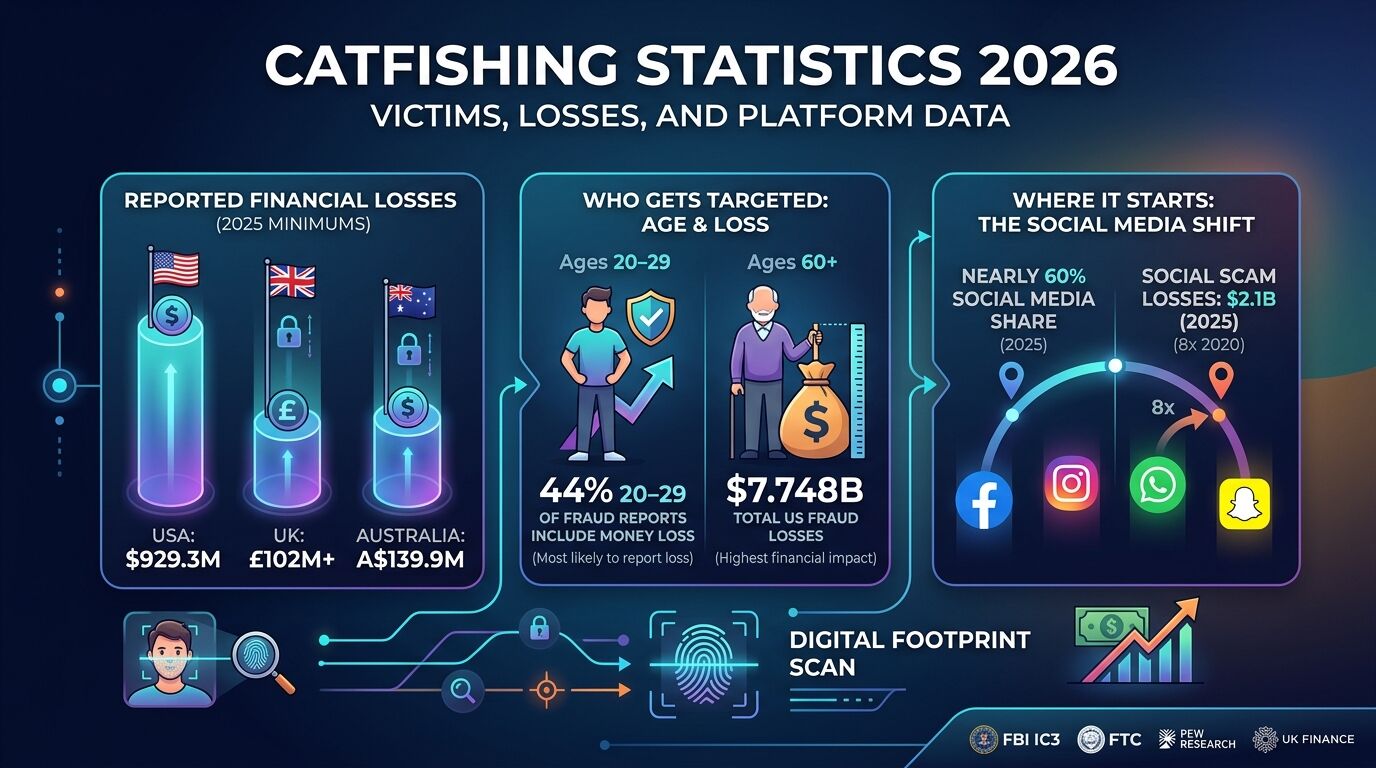
FTC 2024 Consumer Sentinel data shows adults aged 20–29 reported losing money in 44% of their fraud reports, compared with 24% for ages 70–79 and 21% for ages 80+. But the totals invert sharply: in 2025, US adults aged 60+ filed 201,266 complaints reporting $7.748 billion in fraud losses (FBI IC3 2025 Internet Crime Report).
| Figure | Group | What it measures |
|---|---|---|
| 44% | US ages 20–29 | Most likely to report losing money |
| $7.748B | US ages 60+ | Highest total fraud losses (2025) |
| ~50% | UK ages 55–74 | Share of total romance fraud value stolen |
| A$99.6M | Australia ages 65+ | Highest Scamwatch losses (2024) |
Two further patterns from the same data. In the UK in 2025, men were more likely to be catfished and asked for money, but women lost more overall. In Australia, romance scams were the second-highest-loss scam category for every age bracket from 45 upward.
Where Catfishing Starts: The Social Media Shift
The origin point has moved decisively. In 2022, 40% of romance scam loss reports began on social media versus 19% on a website or app. By 2025 the FTC put the social media share at nearly 60%.
Social media scam losses reached $2.1 billion in 2025 — roughly eight times the 2020 figure.
By platform, in 2022 Instagram accounted for 29% of scam reports and Facebook 28%. In 2023, 21% of romance scam losses occurred on Facebook and Instagram, with Snapchat appearing in 8% of reports. By 2025, Facebook carried the highest reported scam losses of any app, followed by WhatsApp and Instagram.
Australian Scamwatch data breaks it down further:
| Platform | Reports | Reported losses |
|---|---|---|
| 347 | A$976K | |
| 325 | A$2M+ | |
| Skype | 90 | A$758K |
| Viber | 23 | A$909K |
| 21 | A$130K | |
| Twitter/X | 16 | A$5.8K |
Social media accounted for over 33% of Australian dating and romance scam losses — A$9.1 million. A UK review of 60 romance fraud cases found 85% began through online relationships.
The second move is almost always the same: get the conversation into a private channel. Around 40% of 2022 reports described a shift to WhatsApp, Telegram, or Google Chat.
Sextortion follows the same route. In 2022, 58% of sextortion-style reports identified social media as the contact method, concentrated on Instagram and Snapchat — and people aged 18–29 were over six times as likely as those 30+ to report it.
Catfishing on Dating Apps
53% of online daters told Pew they had encountered someone who misrepresented themselves — about age, appearance, employment, lifestyle, or intentions.
Exposure isn’t evenly distributed:
- 63% of men under 50 report encountering scams — the highest of any group
- Lower- and middle-income users report higher exposure than higher-income users
- Around six in ten Hispanic or Black online daters report it, versus about half of White users
For scale on the app side: in 2019, Australian online dating sites generated 665 dating and romance scam reports and over A$7.8 million in losses. Tinder alone accounted for 176 reports and roughly A$814,000.
The Recurring Red Flags
Fraud guidance across agencies converges on the same warning signs: rapid emotional bonding, a push to move the conversation private, and an eventual financial request.
| Red flag | What it looks like |
|---|---|
| Thin profile | Few posts, no tagged photos, no organic history |
| Stolen or generated photos | Professionally shot or uncannily flawless images |
| Love bombing | Intense romantic escalation within days |
| Verification excuses | Video calls and meetups refused indefinitely |
| Shifting details | Job, location, and life story change over time |
| The request | Money, crypto, gifts, medical costs, investments, or nudes |
Catfishing itself splits into recognisable types: romance catfishing (feigned love to gain trust), financial catfishing, social media impersonation, dating app catfishing, sextortion, identity theft, AI catfishing, pig butchering (long-term grooming toward a fake investment), and harassment or revenge accounts.
It’s worth distinguishing from phishing: catfishing uses a fabricated identity and emotional manipulation over time, while phishing impersonates a known person or business to steal credentials quickly. Fraud investigators often summarise the romance version as the four P’s — Pretend, Problem, Pressure, Pay.
AI Catfishing and Deepfakes
The FBI has stated that AI has materially lowered the barrier to catfishing. In 2025, victims lost over $19 million to catfish scams with a likely AI component — generated profiles, AI-written scripts, or both.
What AI removes is the friction that used to expose fake profiles. Scammers can now produce:
- Profile photos of people who don’t exist — nothing to reverse image search against
- Fluent, error-free bios and messages in any language
- Emotionally tailored scripts adapted to each target
- Fabricated voice notes and short video clips
- Altered appearance, gender, or apparent age from a real base photo
This is why AI image detection has become a standard feature in face search tools rather than a novelty. A photo that returns zero matches used to suggest a private person; now it can equally suggest a face that was generated last week.
Financial and Emotional Cost
Reported losses, most recent year available:
| Country | Romance scam losses (2025) | Prior year |
|---|---|---|
| United States | $929.3M | $672M (2024) |
| United Kingdom | £102M+ | £30.5M via UK Finance cases (2024) |
| Australia | A$139.9M | A$156.8M (2024) |
US imposter-related incidents caused $2.95 billion in losses in 2024. In the UK, the average individual romance fraud loss was £9,500, with some single victims losing as much as £1 million.
Catfishing is no longer a quick “send me money” scam. It blends romance fraud with months of grooming, fake investment platforms, and crypto — which is why individual losses have grown so much faster than case counts.
The non-financial cost is documented and substantial: research on catfishing victims reports lasting trust issues and depression, lingering attachment to a person who never existed, anger and embarrassment, and reluctance to date or meet people online again.
There’s also a second victim in most cases. When a scammer uses a real person’s face, name, or profile, that person is pulled into something they had no part in — receiving accusations from strangers, having their reputation questioned, and often being unable to get the fake accounts removed.
Why These Numbers Are Almost Certainly Too Low
Two reasons, and both matter for how you read everything above.
Catfishing isn’t recorded consistently. One case is logged as romance fraud, another as an imposter scam, another as sextortion, blackmail, harassment, or identity theft. Countries, agencies, and platforms all categorise differently, so no single figure captures the whole category.
Most victims never report. Shame and self-blame are the dominant reasons. Some still have feelings for the person. Many don’t realise what happened until much later, and those with intimate images at stake often stay silent specifically to avoid exposure. One study found only 4.8% of people who experienced mass-market consumer fraud complained to a government entity or the Better Business Bureau.
Treat every official figure here as a minimum confirmed count rather than a measurement of the problem.
Protecting Yourself
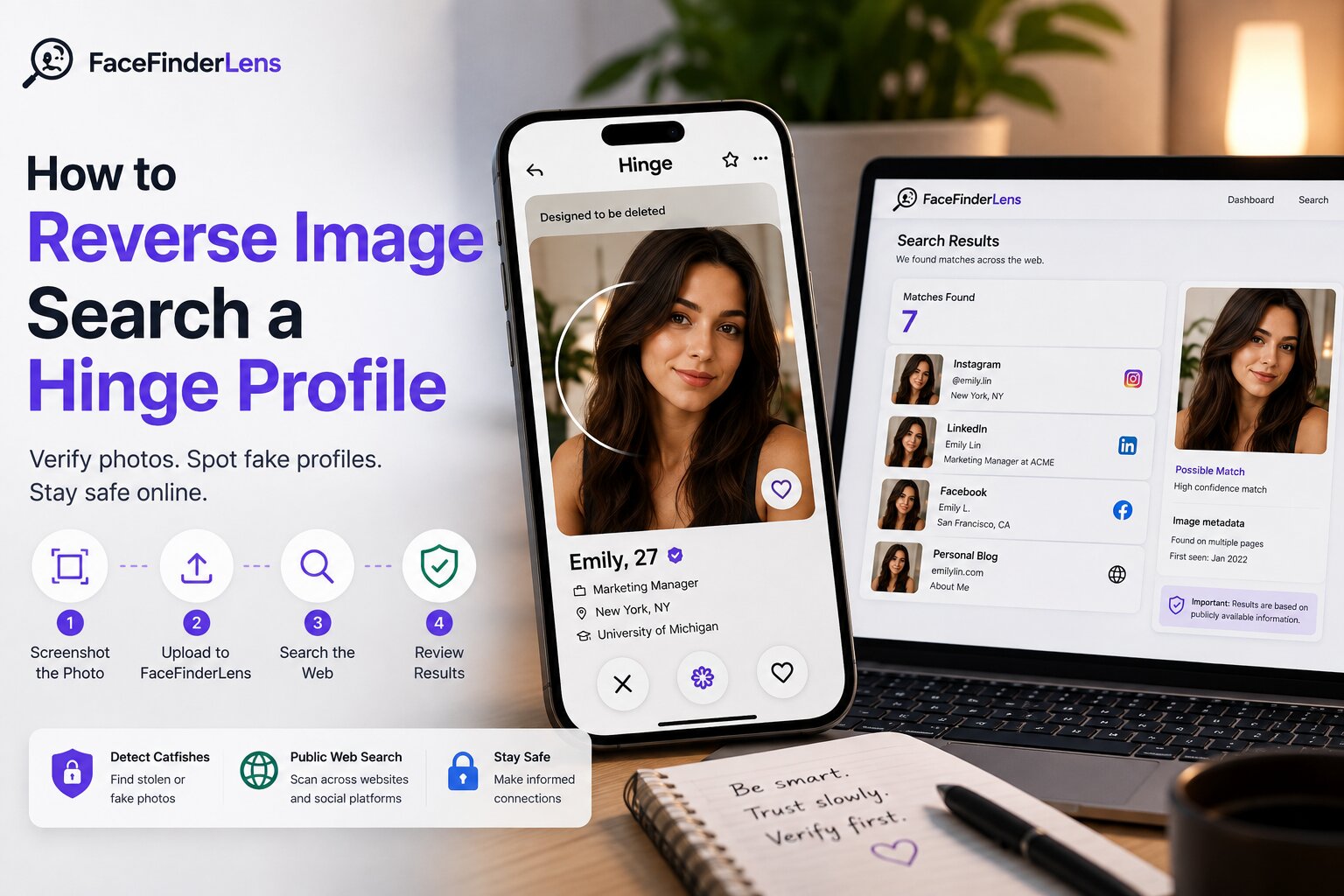
The data points consistently at one practical intervention: verify the photo before the relationship progresses. Stolen images are the foundation of most catfish profiles, and they’re the one element that can be checked independently in under two minutes.
A reverse face search shows where else a profile photo appears online — other dating profiles, social accounts under different names, model portfolios, and scam reports.
FaceFinderLens handles cropped, filtered, and compressed screenshots, and flags likely AI-generated images. Searches start at $3.95 for three lookups, with no subscription.
Sources
- FBI Internet Crime Complaint Center (IC3) — 2024 and 2025 Internet Crime Reports
- FTC Consumer Sentinel Network Data Book 2024; FTC reports on social media scam losses and romance scams
- Pew Research Center — online dating and online scams research
- UK Finance Annual Fraud Report 2025; City of London Police
- Australian Scamwatch / ACCC; eSafety Commissioner (Australia)
- Global Anti-Scam Alliance (GASA)
- Lauder & March (2023), Computers in Human Behavior; SAGE Journals; Bournemouth University research repository
- NIST glossary (phishing definition); INTERPOL
Frequently Asked Questions
How common is catfishing on dating apps?
Around 52% of US dating app users believe they’ve encountered a scammer or catfish, rising to 62% among recent users and 72% among men. Roughly 53% report encountering someone who misrepresented themselves in some way.
Who is most likely to be targeted by a romance scam?
Adults aged 20–29 report losing money most often, but adults aged 60+ account for by far the largest total losses — $7.748 billion in US fraud losses in 2025. Men report being targeted more frequently; women tend to lose more per case.
How much money is lost to romance scams each year?
In 2025, reported losses reached $929.3 million in the US, over £102 million in the UK, and A$139.9 million in Australia. Because most victims never report, these are minimum confirmed figures.
Are AI-generated profiles making catfishing harder to detect?
Yes. The FBI attributed over $19 million in 2025 losses to catfish scams with a likely AI component. AI-generated faces don’t appear anywhere online, which defeats traditional reverse image search — this is why AI image detection is now standard in face search tools.