Romance Scammer Photos: 10 Things to Check Before You Trust a Profile in 2026
Meeting someone online can be exciting. But when most of what you know about a person comes from a few photos, messages, and profile details, it can be difficult to know whether everything is genuine.
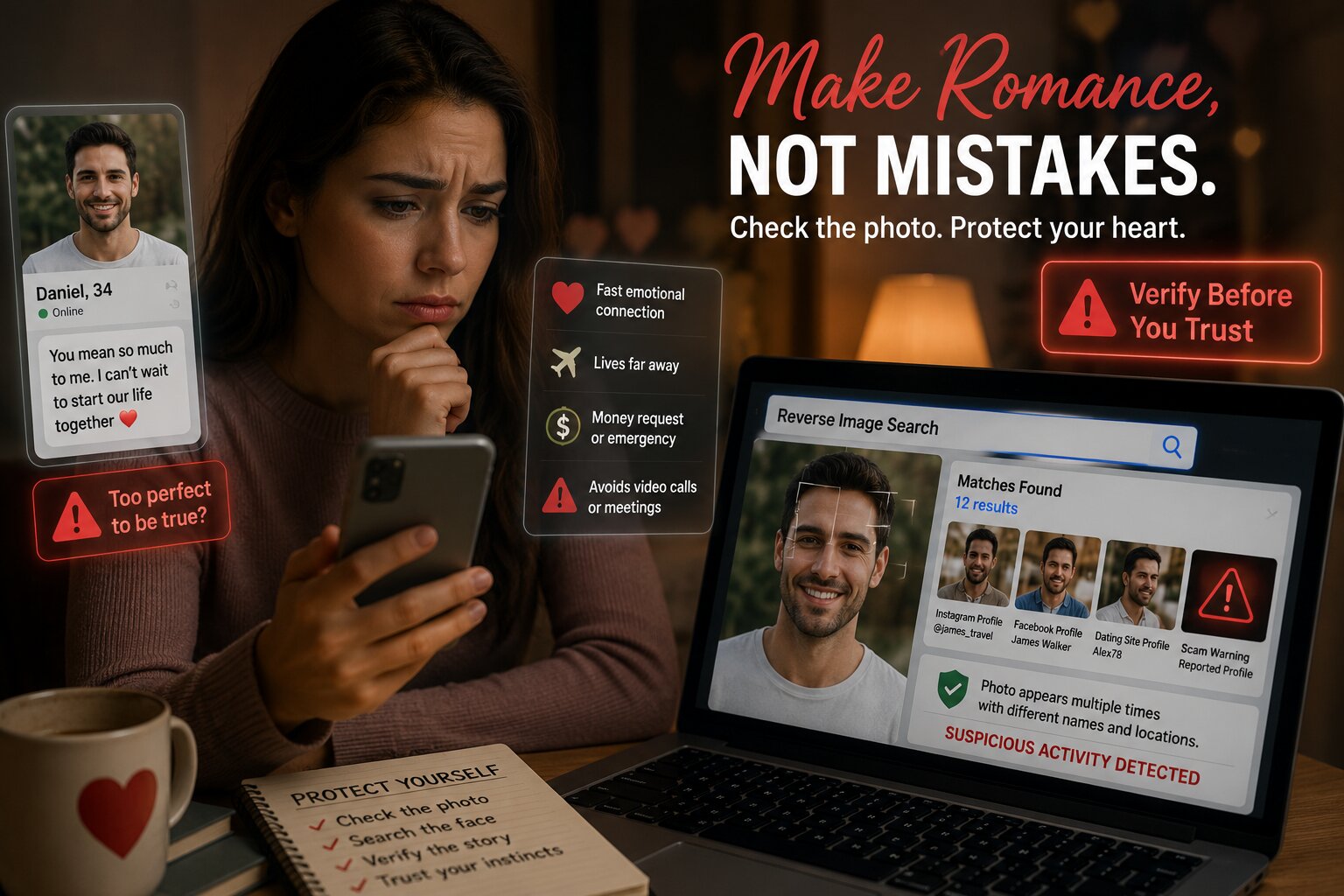
Romance scammers often create convincing online identities to build trust before introducing a financial request, emergency, investment opportunity, or another reason they need help.
The FBI describes romance scams as schemes where criminals use fake online identities to gain affection and trust before manipulating or stealing from their victims. The agency also recommends researching a person’s photo and profile to see whether the same image, name, or information appears elsewhere online.
That does not mean every unusual photo or incomplete dating profile is fraudulent.
A photo should be treated as one piece of information, not proof that someone is or is not a scammer.
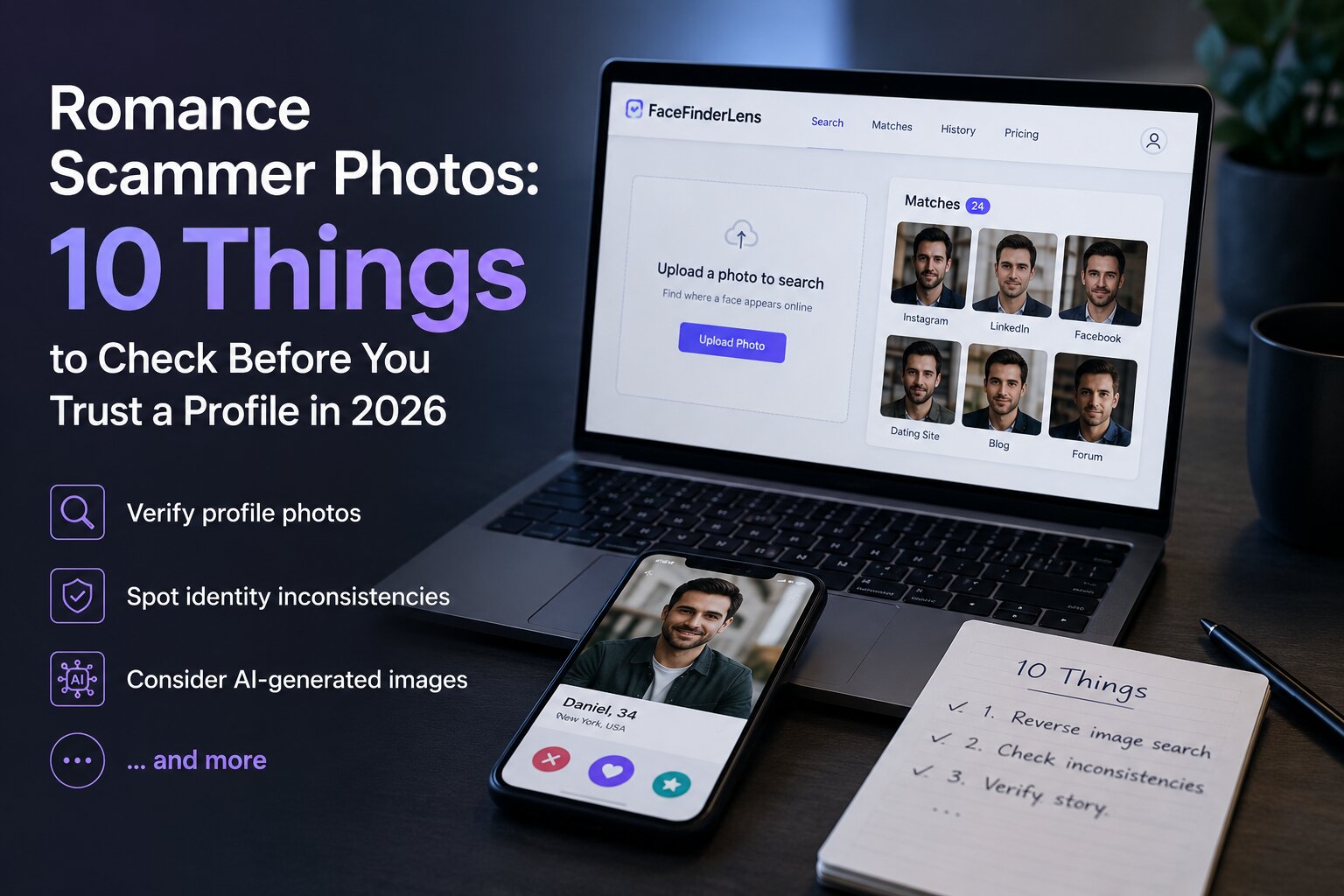
Here are 10 things worth checking before you trust a dating profile.
1. Check Whether the Same Face Appears Under Another Name
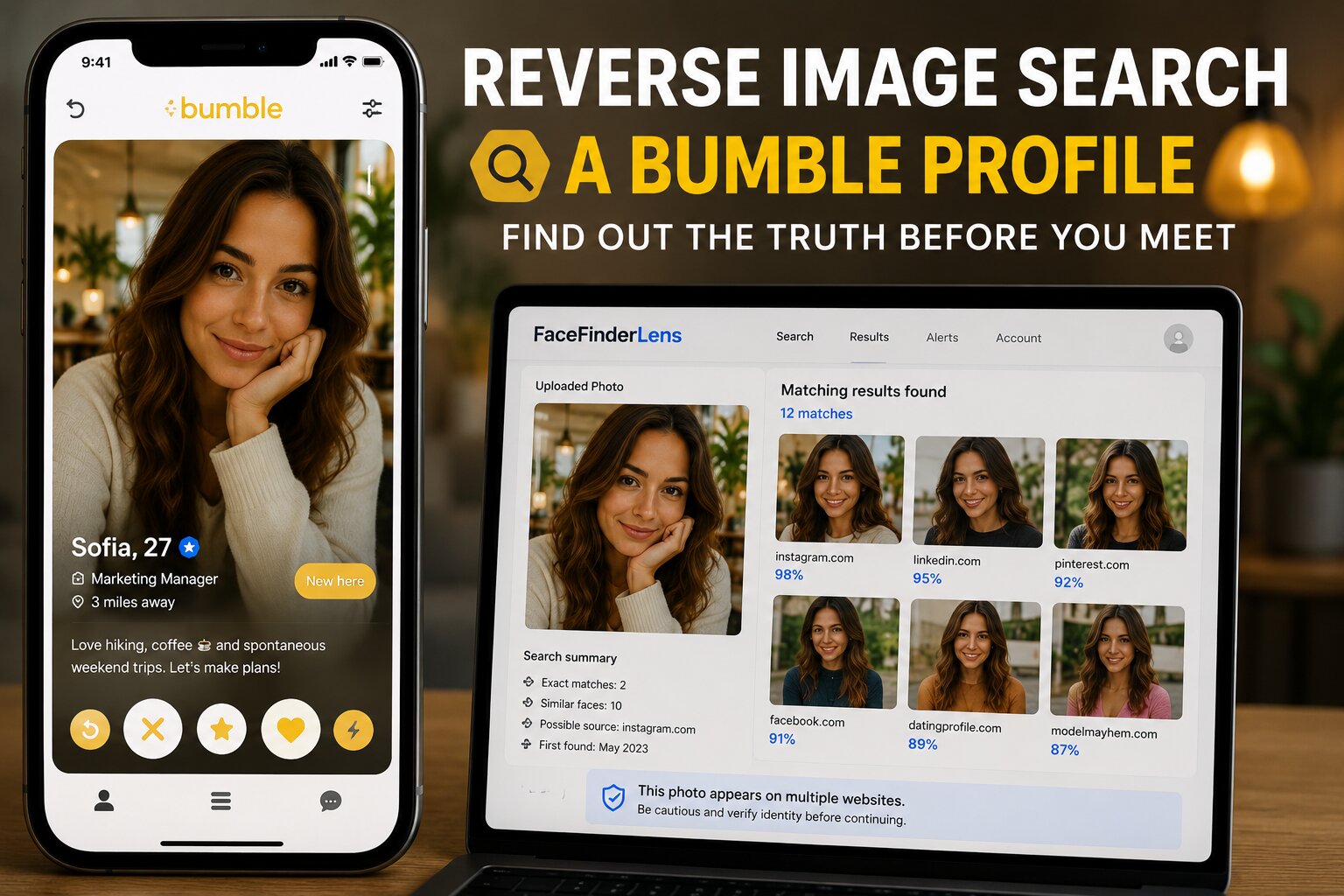
One of the simplest checks is searching the person’s profile photo to see whether the same or a similar face appears elsewhere online.
A reused photo may appear on:
- another dating profile;
- an old social media account;
- a professional website;
- an unrelated person’s profile;
- public webpages;
- scam-warning pages;
- other publicly accessible sources.
Finding the same photo under a completely different identity can be a significant warning sign.
However, context matters.
People legitimately reuse their own photos across Instagram, LinkedIn, Facebook, dating apps, company websites, and other platforms.
The important question is not simply:
“Does this photo exist somewhere else?”
It is:
“Do the identity and context surrounding the photo make sense?”
2. Look for Major Identity Inconsistencies
Suppose someone introduces themselves as “Michael, 38, from Chicago.”
You search one of their photos and discover that the same face appears repeatedly with a different name, location, profession, or identity.
That deserves further verification.
Look for inconsistencies involving:
- names;
- locations;
- ages;
- occupations;
- usernames;
- biographical information;
- social profiles;
- dates.
One small discrepancy does not automatically indicate fraud. People change usernames, move cities, change jobs, and use old photos.
Several major inconsistencies together are much more concerning.
3. Don’t Assume a Professional-Looking Photo Is Proof of Identity
A polished profile photo can create a strong first impression.
But image quality does not verify who uploaded it.
Photos can be copied from publicly accessible profiles, websites, social media pages, portfolios, or other sources without the knowledge of the person shown in them.
Likewise, an ordinary selfie does not automatically prove authenticity.
Instead of judging whether someone “looks trustworthy,” verify whether their photos and their story are consistent.
Appearance is not evidence of identity.
4. Check More Than One Photo
Searching only one photograph can produce an incomplete picture.
If you legitimately have access to several profile photos, checking more than one can sometimes provide useful context.
For example:
- one image might have no useful matches;
- another might appear on an older social profile;
- another may appear under conflicting identity information.
This is especially useful when a profile contains photos taken at different times or from different angles.
With FaceFinderLens, you can use a clear profile photo to look for visually similar faces appearing on publicly available webpages.
The goal should be verification — not identifying, tracking, harassing, or exposing someone.
5. Consider Whether the Photos Could Be AI-Generated
AI-generated people have become increasingly realistic.
As a result, you should not automatically assume that a face belongs to a real person simply because the photograph looks convincing.
The FTC warned in 2026 that AI and other technologies can make romance scams more difficult to recognize.
Possible visual inconsistencies can sometimes include unusual:
- backgrounds;
- reflections;
- text;
- accessories;
- jewelry;
- fingers;
- hair edges;
- lighting;
- repeated facial details.
But none of these signs alone proves that a picture was created using AI.
Modern AI images can look extremely realistic, while ordinary photographs can also contain compression artifacts, filters, editing, or unusual lighting.
That is why visual inspection should be combined with other verification methods.
6. Ask Whether Their Story Matches Their Online Presence
Photos are only one part of an online identity.
Look at the bigger picture.
If someone says they have lived in a city for many years, works in a particular profession, or has a long-established social presence, does the publicly available information you find broadly support that story?
You do not need to investigate someone’s private life.
Instead, look for obvious contradictions in information they have voluntarily shared with you.
For example, be cautious when:
- basic details repeatedly change;
- explanations become inconsistent;
- timelines do not make sense;
- every verification question produces another complicated excuse.
The FBI recommends going slowly and asking questions when getting to know someone online.
7. Pay Attention If They Constantly Avoid Meeting
Not everyone can meet immediately.
Distance, work, travel, health, family commitments, and privacy concerns can all be legitimate reasons.
The warning sign is a repeated pattern.
Someone may repeatedly plan to meet but cancel at the last moment, or continually provide new reasons why meeting is impossible.
The FTC specifically lists repeated inability to meet in person as a common warning sign associated with romance scams.
When avoidance is combined with identity inconsistencies or requests for money, the situation deserves much more caution.
8. Treat Unexpected Requests for Money as a Major Red Flag
This is much more significant than whether a photograph looks suspicious.
Be extremely cautious when someone you have met only online begins requesting:
- emergency money;
- travel expenses;
- medical expenses;
- gift cards;
- cryptocurrency;
- wire transfers;
- investment funds;
- financial account information;
- help receiving or transferring money.
The FBI advises people never to send money to someone they have communicated with only online or by phone.
The FTC similarly warns against sending money or gifts to an online romantic interest you have not met in person.
A convincing profile photo does not make a financial request safer.
9. Be Careful When Someone Pushes You Off the Dating Platform Immediately
Moving from Tinder, Bumble, Hinge, Grindr, Instagram, Facebook, or another platform to private messaging is not automatically suspicious.
Real people do it every day.
The concern is when someone aggressively pushes you to leave the original platform almost immediately while simultaneously accelerating the relationship.
Scammers may want conversations to happen somewhere with fewer platform protections or reporting mechanisms.
The FBI specifically advises caution when someone quickly asks to leave a dating service or social network and communicate directly.
Take your time.
There is rarely a legitimate reason why someone you just met should pressure you into communicating in a way that makes you uncomfortable.
10. Look at the Pattern — Not One Single Red Flag
This is perhaps the most important rule.
No single sign proves that someone is a romance scammer.
A person could:
- have very few photos;
- dislike video calls;
- travel frequently;
- have an old social media account;
- use professional photographs;
- have almost no searchable web presence.
None of those things alone establishes fraud.
Instead, look for combinations.
For example:
Different identity + repeated meeting excuses + urgent money request
is much more concerning than:
No reverse image search results.
Similarly:
Same face appearing under several unrelated identities + inconsistent biography + pressure to send cryptocurrency
deserves substantially more caution than simply finding someone’s photograph on another website.
Always evaluate the overall pattern.
How to Check a Suspicious Dating Photo with FaceFinderLens
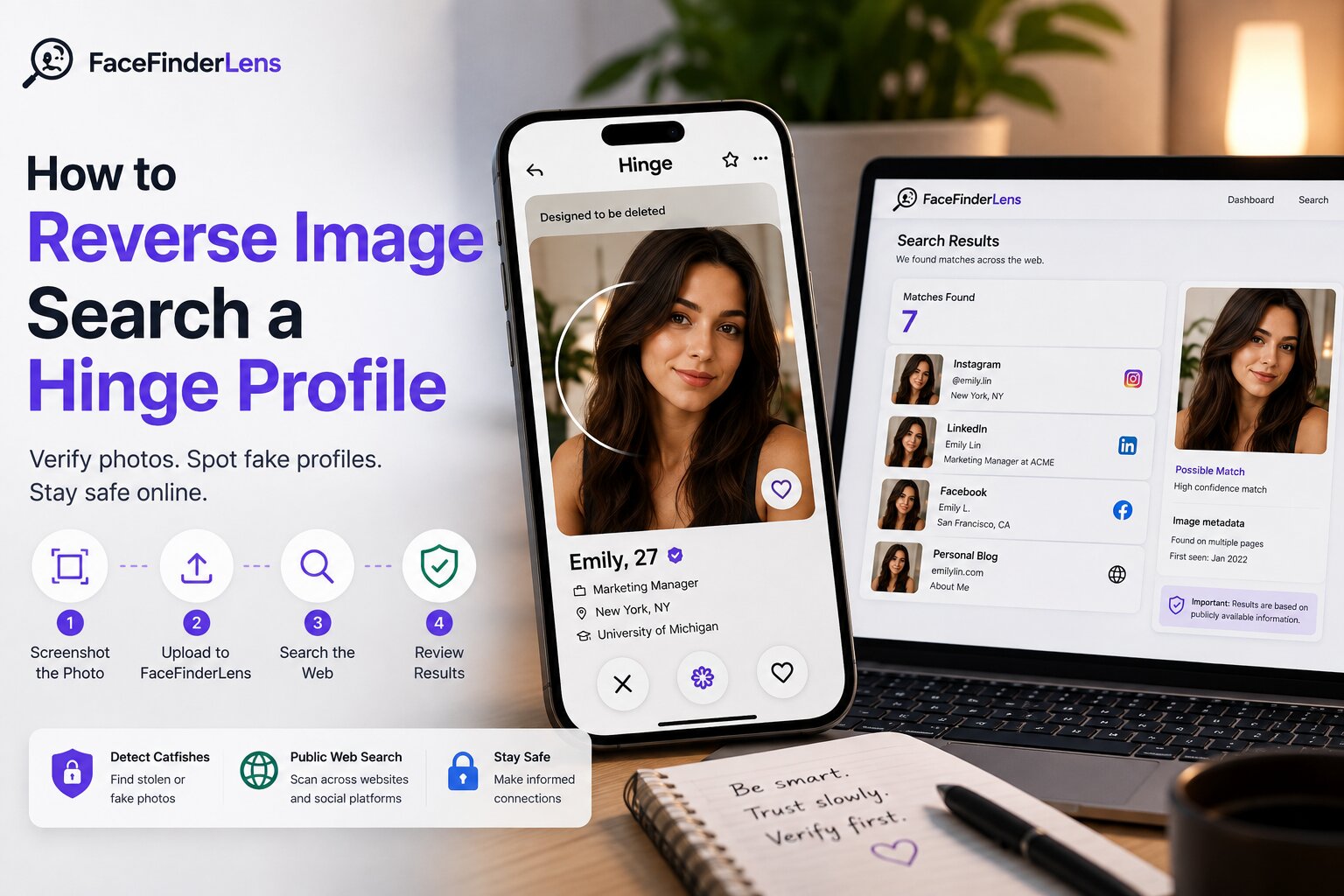
If you have a photo that was legitimately shared with you or displayed publicly on a dating profile, you can use FaceFinderLens as one part of your verification process.
Step 1: Choose a Clear Photo
Whenever possible, use a photo where the face is:
- visible;
- reasonably well lit;
- not heavily covered;
- not extremely small;
- not distorted by strong filters.
Step 2: Upload It to FaceFinderLens
Use FaceFinderLens to search for visually similar faces across supported publicly available web sources.
Step 3: Review the Results Carefully
Do not focus only on whether a match exists.
Look at the context surrounding potential results:
- What name appears?
- Where was the image published?
- Does the location match?
- Does the biography make sense?
- Is it clearly the same person or only someone who looks similar?
Step 4: Verify With Additional Information
A face-search result should not be treated as definitive proof of identity or wrongdoing.
Use it together with:
- information voluntarily shared by the person;
- normal online searches;
- profile consistency;
- communication patterns;
- other legitimate verification methods.
Face search works best as a verification signal, not a final verdict.
What If FaceFinderLens Finds No Matches?
No results do not automatically mean the profile is genuine.
A photograph may:
- never have been publicly indexed;
- come from a private social profile;
- be relatively new;
- have been cropped or edited;
- exist only on platforms that are not searchable;
- have been generated using AI.
Conversely, finding similar images online does not automatically mean someone is committing fraud.
Always investigate the context before drawing conclusions.
What Should You Do If You Suspect a Romance Scam?
If several warning signs appear together, prioritize your safety.
Consider:
- Stop sending money or financial information.
- Do not provide passwords, banking credentials, identification documents, or other sensitive information.
- Save relevant messages and transaction information if you may need to make a report.
- Stop communicating if you believe the interaction is fraudulent.
- Report suspicious activity to the dating or social media platform involved.
- Contact your bank or payment provider quickly if you have already transferred money.
- Report suspected fraud to the appropriate authorities in your country.
For people in the United States, the FBI directs victims of romance scams to the Internet Crime Complaint Center (IC3), while the FTC accepts fraud reports through its official fraud-reporting service.
What You Should NOT Do
Discovering suspicious information does not give you permission to harass, threaten, impersonate, expose, or publicly accuse someone.
Avoid:
- publishing someone’s personal information;
- attempting to access private accounts;
- guessing passwords;
- bypassing account security;
- impersonating the person;
- threatening them;
- contacting their family or employer to embarrass them;
- publicly labeling someone a criminal without reliable evidence.
Use publicly available information responsibly.
If you believe actual fraud has occurred, preserve relevant evidence and report the matter through the platform, financial institution, or appropriate authorities rather than trying to take matters into your own hands.
A Photo Match Is a Clue — Not a Conviction
Reverse face search can provide useful context about an online profile.
It can sometimes reveal that a profile photograph has appeared elsewhere, show older versions of an image, or uncover identity information that does not match what you were told.
But technology has limitations.
Similar-looking people exist. Search results can be incomplete. Public information can be outdated. AI-generated images add another layer of uncertainty.
That is why FaceFinderLens should be used as one part of a broader verification process.
Check the photo. Check the story. Check the behavior.
And when money enters an online relationship with someone you have never met, increase your level of caution immediately.
Frequently Asked Questions
Can a reverse face search prove someone is a scammer?
No.
A reverse face search can help identify inconsistencies or show where a similar face appears online, but it cannot by itself establish that someone committed fraud.
Use search results as additional information that requires context.
What does it mean if the same photo appears under another name?
It may indicate that the photograph has been reused, copied, reposted, or associated with another identity.
It can be a strong reason to verify further, but you should confirm the context before making conclusions.
Can romance scammers use real people’s photos?
Yes.
Fake online identities can use photos belonging to real people who have no involvement in the scam.
This is another reason not to attack or publicly accuse the person whose face appears in a stolen photograph.
Can scammers use AI-generated faces?
AI-generated images can be used to create convincing fictional identities.
Because these faces may never have appeared elsewhere online, traditional reverse-image searches may return little or no information.
A lack of search results therefore should not automatically be considered proof that a profile is authentic.
Should I send money if someone says they have an emergency?
Sending money to someone you know only through online communication carries significant risk.
Both the FBI and FTC recommend extreme caution and advise against sending money to romantic interests you have not met in person.
Is it legal to reverse search a dating profile photo?
Laws and platform rules vary by location and circumstances.
Using publicly accessible information for ordinary personal verification is different from using technology to stalk, harass, discriminate against, impersonate, or expose another person.
Use FaceFinderLens responsibly and comply with applicable laws, privacy rights, and platform terms.
Final Thoughts
Online dating should not require you to become a private investigator.
But taking a few minutes to verify an unfamiliar profile can help you make more informed decisions.
If something feels inconsistent, slow the conversation down.
Check the profile photo.
Compare the story with publicly available information.
Pay close attention to requests involving money.
And remember that a search result is information to evaluate — not permission to accuse someone of wrongdoing.
Want to check a suspicious profile photo?
Use FaceFinderLens to search for visually similar faces and see whether the image may appear elsewhere online.
Use the results responsibly, respect other people’s privacy, and always combine photo verification with common-sense online safety.